


Boiler Pressure Too High or Low? Here’s What Normal Looks Like and What to Do

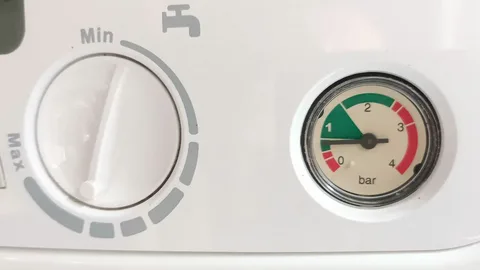
If you’ve ever glanced at your boiler’s pressure gauge and wondered whether the reading is normal, you’re not alone. Boiler pressure is one of the most common things Ontario homeowners notice, and one of the least understood. The good news is that pressure issues are usually diagnosable, and many have straightforward causes. Here’s what the numbers mean, what’s normal, and when the problem needs professional attention.
What Is Normal Boiler Pressure for a Residential System in Ontario?
For most residential hydronic (hot water) boilers found in Ontario homes, normal pressure falls in these ranges:
- Cold system (boiler off): 12–15 PSI (roughly 1.0–1.5 bar)
- Operating (heating cycle running): 18–25 PSI (roughly 1.5–2.0 bar)
- Pressure relief valve activates at: 30 PSI, this is the safety threshold, not a target
A small pressure rise when the boiler fires up is completely normal, water expands as it heats, so the gauge will climb. What matters is that it stays within the operating range and returns to the cold range when the system cools down. If your gauge has a green zone marked, that’s your target range. You can book a boiler repair assessment if the reading is consistently outside these numbers.
What Causes Low Boiler Pressure, and How to Identify It
Low pressure is the more common of the two problems. When pressure drops below 12 PSI, most boilers have a built-in safety mechanism that shuts the system down to prevent dry firing. Signs include the boiler not firing, radiators not heating, or an error code on the display.
Common causes of low boiler pressure:
- A small leak somewhere in the system, even a slow drip at a radiator valve, pipe fitting, or the boiler itself will cause gradual pressure loss over days or weeks
- Recently bled radiators, bleeding air from radiators releases a small amount of water along with the air, which drops system pressure
- A faulty or worn pressure relief valve, if the PRV has been leaking or discharging, it releases water and reduces pressure
- A failed expansion tank, the expansion tank absorbs pressure increases during heating; if it fails, pressure swings become erratic
If pressure drops repeatedly after being topped up, there’s an underlying cause that needs to be found. Contact HVAC Near Me for a boiler inspection, recurring pressure loss almost always means a leak or component issue, not just a need for more water.
What Causes High Boiler Pressure, and Why It Matters
High pressure, consistently above 25 PSI or rising sharply toward 30 PSI, puts strain on the boiler’s seals, fittings, and heat exchanger. At 30 PSI, the pressure relief valve is designed to open and discharge water to protect the system. A PRV that discharges repeatedly isn’t solving the problem, it’s a symptom that something is driving pressure too high.
Common causes of high boiler pressure:
- A failed or waterlogged expansion tank, the most frequent cause; when the expansion tank can’t absorb pressure increases, the system has nowhere to go and pressure spikes
- The pressure reducing valve (PRV) stuck open, this valve controls how much water enters the system from the main supply; if stuck open, it keeps adding water and pressure builds
- Overfilling during a top-up, adding too much water manually raises the cold pressure above the normal range, and operating pressure then exceeds 30 PSI
If your PRV is discharging water regularly, do not cap it or ignore it. It means the system is operating at unsafe pressure. You can read more about boiler maintenance fundamentals in the complete homeowner’s guide to boiler maintenance.
How to Check Your Boiler Pressure Gauge
Most residential boilers have a round pressure gauge on the front panel, either analog (with a needle) or digital (displayed on a screen). Here’s how to read it:
- Find the gauge: typically located on the front or side of the boiler unit
- Check the cold reading: with the boiler off and the system cooled down, pressure should sit between 12 and 15 PSI
- Check the operating reading: when the boiler is running, pressure should rise to 18–25 PSI and stabilize
- Look for a green zone: many gauges have a marked safe range, the needle should stay within it during normal operation
If the needle is in the red zone or the digital display shows a pressure error code, don’t restart the boiler repeatedly. Note the reading and call a technician. You can browse available boiler models if your system is aging and repeated pressure issues suggest it may be approaching end of life.
What You Can Do vs. What Needs a Technician
Some pressure issues have simple causes a homeowner can address. Others require a licensed technician.
You can safely:
- Check the pressure gauge reading and note whether it’s high or low
- Check for visible leaks around radiator valves, pipe joints, or the boiler itself
- Confirm the system has been bled recently and whether that caused the pressure drop
Call a licensed technician for:
- Pressure that keeps dropping despite topping up, indicates an active leak
- A pressure relief valve that is dripping or discharging water
- Pressure consistently above 25 PSI with no clear cause
- Error codes on the boiler display related to pressure
- Any work involving the expansion tank, PRV, or water feeder valve
Gas and pressurized systems require a TSSA-licensed technician in Ontario, do not attempt to adjust internal components yourself. Contact HVAC Near Me for same-day boiler pressure diagnosis across the GTA.