


What Temperature Should a Water Heater Be Set To?

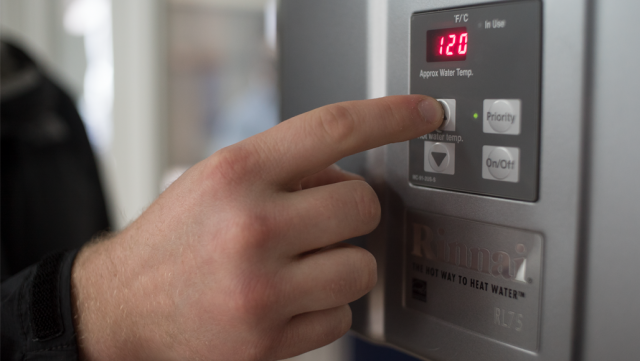
It seems like a simple question, but the answer involves balancing two competing safety risks: harmful bacteria at low temperatures and scalding at high ones. Many homeowners are tempted to turn their water heater down to save energy, but in Canada, that can create a real health hazard. This guide explains the recommended setting, why it matters, and how to stay safe on both fronts, based on Health Canada and Canadian plumbing code guidance.
What Temperature Should Your Water Heater Be Set To?
The recommended setting is 60°C (140°F). This is the standard that water heaters in Canada come factory-set to, as mandated by the National Plumbing Code, CSA, and the World Health Organization.
The reason is bacteria. At temperatures below 60°C, the tank can become a breeding ground for Legionella, the bacteria that causes Legionnaires’ disease, a serious form of pneumonia. Storing water at 60°C keeps that risk in check. Health Canada’s official guidance is clear: set your water heater to 60°C (140°F) to prevent the growth of harmful bacteria.
If your hot water has felt lukewarm lately or you suspect the setting has drifted, book a water heater inspection to have it checked.
Why You Shouldn’t Turn Your Water Heater Below 60°C
Almost every energy-saving checklist suggests lowering your water heater to 49°C (120°F) to cut costs. In the United States this is common advice, but in Canada, health authorities specifically advise against it for the tank temperature.
Here’s why the temperature range matters for Legionella:
- Between 25°C and 50°C: Legionella multiplies readily, this is the danger zone
- At 55°C: Bacteria die within 5–6 hours
- At 60°C: Bacteria die within about 32 minutes
- Above 70°C: Legionella dies almost instantly
Canadian studies have found that even at 60°C, a significant share of electric water heaters can harbour bacteria at the cooler bottom of the tank, which is exactly why going below 60°C isn’t recommended. Turning the tank down to save money can backfire into a genuine health risk.
The Scalding Risk at 60°C, and How to Manage It
There’s a real tradeoff here, and it’s important to understand both sides. While 60°C protects against bacteria, water at that temperature is hot enough to cause serious burns.
At 60°C, water can cause third-degree burns on an adult in about six seconds. For young children, whose skin is far more delicate, a serious scald can happen in as little as one second. The elderly and people with certain medical conditions are also at higher risk. This is not a reason to lower the tank, it’s a reason to manage the water at the point of use.
The Right Solution, Store Hot, Deliver Cooler
The safest approach recommended by Canadian health authorities is to store the water hot and deliver it cooler. This is done with a mixing valve (also called a tempering or anti-scald valve).
- The water heater tank stays at 60°C to control bacteria
- A mixing valve blends in cold water after it leaves the tank, delivering water to your taps at a safer 49°C (120°F) or lower
This gives you the best of both: bacteria control inside the tank and scald protection at the faucet. Mixing valves can be installed on the water heater itself or at individual fixtures. Installation should be done by a licensed technician. You can browse water heater models if you’re considering an upgrade, many newer units accommodate this setup.
How to Check and Adjust Your Water Heater Temperature
If you want to verify your current setting:
- Gas water heaters: The temperature dial is on the gas control valve near the bottom of the tank, usually marked with settings rather than exact numbers
- Electric water heaters: The thermostats are behind access panels on the tank and require removing a cover to check, this involves working near electrical components
- The most accurate check: Run hot water at the tap closest to the tank for a few minutes, then measure with a thermometer
Because adjusting an electric water heater involves electrical safety and both types involve the Legionella-versus-scald balance, it’s worth having a technician confirm the setup, especially if you have young children or elderly family members. If you’ve noticed other issues alongside temperature concerns, why does my hot water run out so fast covers related warning signs, and 6 signs it’s time to replace your water heater helps you tell whether the unit is nearing end of life.
When Should You Call an HVAC Professional?
Contact a licensed technician if:
- Your hot water feels lukewarm even with the setting at 60°C, this can signal a failing element or thermostat
- You want a mixing valve installed to protect against scalding
- You have young children or elderly family members and want the delivery temperature made safe
- The temperature fluctuates unpredictably between hot and cold
- You’re unsure whether your tank is actually holding 60°C
Getting the temperature right is one of the few water heater settings that’s genuinely a safety issue, not just comfort or cost. Contact HVAC Near Me for a water heater assessment across Ontario.
This article covers general safety guidance. For advice specific to your household, especially homes with infants, elderly residents, or anyone with a compromised immune system, consult a licensed plumber or your local public health authority.