


Navien vs. Rinnai: Choosing the Best Tankless Water Heater

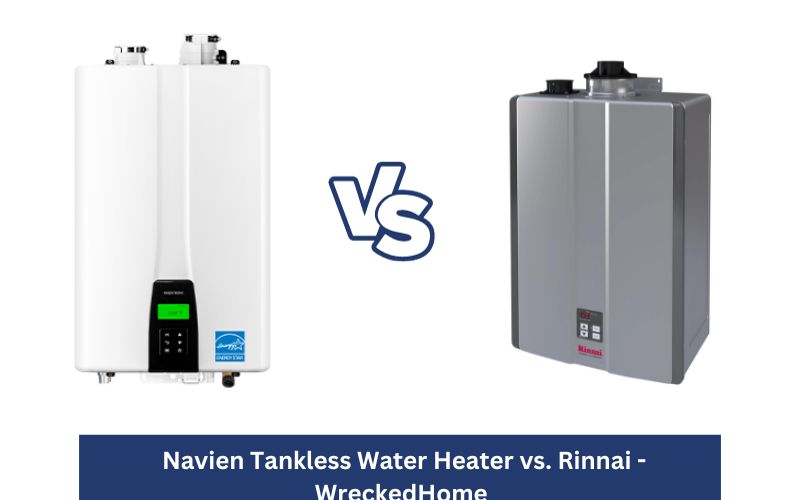
If you’ve decided to go tankless, the next question almost always comes down to brand. Navien and Rinnai are two of the most widely installed tankless water heater brands in Ontario, both condensing, both high-efficiency, and both with strong track records in Canadian homes. The question isn’t which one is better in an absolute sense, but which one is the better fit for your home and household.
This comparison looks at how they differ across the specs and features that actually matter to homeowners.
A Quick Look at Both Brands
Navien is a South Korean manufacturer that entered the North American market in the mid-2000s and has grown quickly, particularly in Canada. Their NPE series has become one of the most common tankless units in Ontario homes and is especially recognized for its built-in recirculation system on select models.
Rinnai is a Japanese brand with decades of history in tankless water heating and one of the earliest manufacturers to bring the technology to North America. Their RX and RXP series are widely installed across Canada and are known for reliable, straightforward performance.
Both brands are condensing units, meaning they extract additional heat from exhaust gases to push efficiency higher, an important feature given Ontario’s cold incoming water temperatures in winter.
Efficiency
Both Navien and Rinnai produce condensing tankless units with Energy Factor (EF) ratings in the high 0.90s, which puts them in the same efficiency tier for most practical purposes.
Where they differ slightly is in how they achieve that efficiency. Navien’s NPE series uses a dual stainless steel heat exchanger design. Rinnai’s RXP series uses a similar condensing approach with their own heat exchanger configuration. In real-world Ontario conditions with cold groundwater in winter both perform consistently when properly sized.
Flow Rate and Sizing
Both brands offer a range of GPM capacities to match different household sizes. Here’s a side-by-side look at the models we carry:
Navien:
- Navien Tankless Water Heater – 8.4 GPM – 150,000 BTU – Model NPE-180S2: suitable for 2–3 occupants
- Navien Tankless Water Heater – 8.4 GPM – 150,000 BTU – Model NPE-180A2: suitable for 2–3 occupants, with recirculation
- Navien Tankless Water Heater – 10.1 GPM – 180,000 BTU – Model NPE-210S2: suitable for 3–4 occupants
- Navien Tankless Water Heater – 10.1 GPM – 180,000 BTU – Model NPE-210A2: suitable for 3–4 occupants, with recirculation
- Navien Tankless Water Heater – 11.2 GPM – 199,000 BTU – Model NPE-240S2: suitable for 4–5 occupants
- Navien Tankless Water Heater – 11.2 GPM – 199,000 BTU – Model NPE-240A2: suitable for 4–5 occupants, with recirculation
Rinnai:
- Rinnai Tankless Water Heater – 9 GPM – 160,000 BTU – Model RXP160IN: suitable for 3–4 occupants
- Rinnai Tankless Water Heater – 11 GPM – 199,000 BTU – Model RX199IN: suitable for 4–5 occupants
When sizing either brand, the key number to watch in Ontario is temperature rise how much the unit needs to heat incoming cold water to reach a comfortable output temperature. In winter, groundwater can come in as cold as 5°C, which puts real demand on any tankless unit. Both brands handle this well when properly sized.
Recirculation
One feature worth highlighting is recirculation, the ability to keep hot water circulating through the pipes so it arrives at the tap almost instantly rather than after a long wait.
Navien’s A-series models (NPE-180A2, NPE-210A2, NPE-240A2) have a built-in recirculation pump. This means no separate pump is required and installation is more straightforward for homes that want this feature.
Rinnai offers recirculation as well, typically through an external recirculation pump or a compatible recirculation kit. It works well, but requires an additional component.
For homes where hot water wait time is a daily frustration, the built-in recirculation on Navien’s A-series is a practical differentiator.
Warranty
Warranty coverage is similar between the two brands, though the specific terms vary by model and registration:
- Navien offers up to 15 years on the heat exchanger and 5 years on parts for residential installations when registered
- Rinnai offers up to 12 years on the heat exchanger and 5 years on parts for residential installations when registered
Both require installation by a licensed technician and product registration to activate full warranty coverage. Always confirm current warranty terms at the time of purchase, as these can be updated by manufacturers.
Installation Considerations
Both units are direct vent and wall-mounted, which makes them well-suited to Ontario homes where space in mechanical rooms is often limited.
Navien units are slightly more compact, which can be an advantage in tighter utility spaces. Rinnai units are also wall-mounted but vary more in dimensions across the lineup.
For either brand, installation requirements are similar: a properly sized gas line, appropriate venting, and for homes with hard water a scale inhibitor or filter to protect the heat exchanger long-term.
Which One Should You Choose?
Both Navien and Rinnai are well-regarded brands that perform reliably in Ontario homes. The right choice often comes down to a few practical factors:
- If built-in recirculation matters to your household, Navien’s A-series handles this without an external pump
- If parts availability and long service history are priorities, Rinnai’s presence in the Canadian market spans decades
- If you’re comparing specific GPM requirements, both brands cover the full range of typical Ontario household sizes
The best starting point is understanding your household’s peak hot water demand and incoming water temperature from there, any qualified installer can help you match those numbers to the right model.
If you’re not sure where to start, our water heater service can assess your current setup and walk you through the options.